Search the site

Italian L2

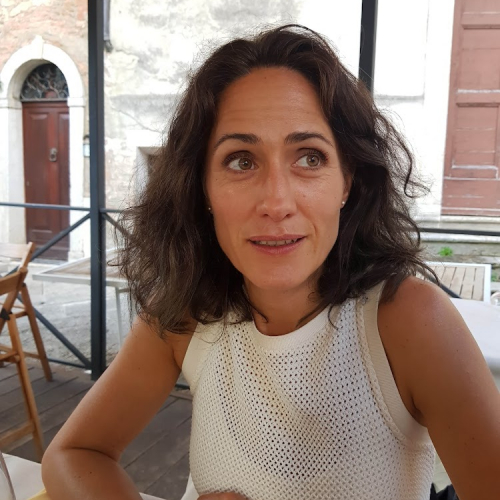
Borbala Samu

borbala samu

Borbala Samu

Docente
Professoressa di II fascia
GLOT-01/B (ex L-LIN/02)
Dipartimento di lingua, letteratura e arti italiane nel mondo (LILAIM)

Nota biografica

Borbala Samu is an associate professor of Modern Language Teaching. She teaches language pedagogy and intercultural communication in undergraduate and graduate programs, and intercultural pragmatics in the PhD program. She is involved in the training and professional development of language teachers both abroad and in Italy. She directs the second-level master's program in teaching Italian as a non-native language and participates in various national and international research projects (including the LMOOC4Slav project). Her research focuses on the application of Cognitive Grammar to teaching Italian as a second language, the development and assessment of pragmatic competence in L2, the development of methodologies and language teaching techniques to foster intercultural communication in multilingual and multiethnic learning contexts, and the new learning environments resulting from the spread of Technology Enhanced Language Learning.

Insegnamenti

2025/2026

  • Apprendere e insegnare le lingue: un'introduzione3 CFU

    Corso di laurea: Master di i livello in didattica dell'italiano lingua non materna

  • Comunicazione interculturale6 CFU

    Corso di laurea: Italiano per l'insegnamento a stranieri

  • Glottodidattica e linguistica educativa ii e laboratorio tell9 CFU

    Corso di laurea: Italiano per l'insegnamento a stranieri

2024/2025

  • Apprendere e insegnare le lingue: un'introduzione4 CFU

    Corso di laurea: Master di i livello in didattica dell'italiano lingua non materna

  • Pragmatica interculturale2 CFU

    Corso di laurea: Studi linguistici, filologici e artistico-letterari

  • Comunicazione interculturale6 CFU

    Corso di laurea: Italiano per l'insegnamento a stranieri

  • Una didattica per l'uguaglianza e l'inclusione1 CFU

    Corso di laurea: Corso di alta formazione "maria montessori: una pedagogia per la pace"

  • Glottodidattica e linguistica educativa ii e laboratorio tell9 CFU

    Corso di laurea: Italiano per l'insegnamento a stranieri

2023/2024

  • Comunicazione interculturale6 CFU

    Corso di laurea: Italiano per l'insegnamento a stranieri

  • Glottodidattica e linguistica educativa ii e laboratorio tell9 CFU

    Corso di laurea: Italiano per l'insegnamento a stranieri

  • Competenze linguistiche e interculturali nell'insegnamento dell'italiano come l26 CFU

    Corso di laurea: Digital humanities per l'italiano
  • Educating for peace in a world of wars, promoting encounter, beauty and health1 CFU

    Corso di laurea: Maria montessori: una pedagogia per la pace

2022/2023

  • Comunicazione interculturale6 CFU

    Corso di laurea: Italiano per l'insegnamento a stranieri

  • Glottodidattica e linguistica educativa ii e laboratorio tell9 CFU

    Corso di laurea: Italiano per l'insegnamento a stranieri

  • Competenze linguistiche e interculturali nell'insegnamento dell'italiano come l26 CFU

    Corso di laurea: Digital humanities per l'italiano
Francesca Malagnini

francesca malagnini

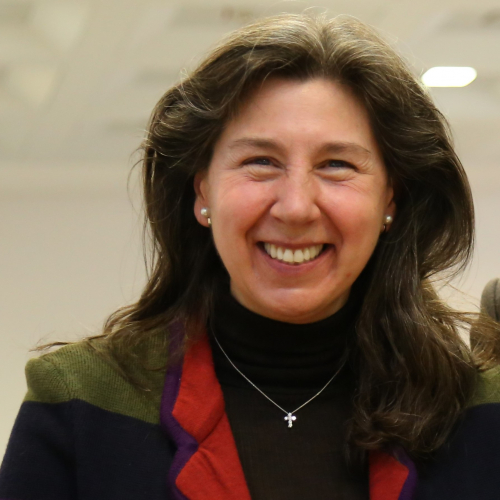
Francesca Malagnini

Docente
Professore di I fascia
LIFI-01/A (ex L-FIL-LET/12)
Dipartimento di lingua, letteratura e arti italiane nel mondo (LILAIM)

Nota biografica

Francesca Malagnini's research activity covers multiple fields. Specifically, she has focused on the analysis of ancient literary texts, with particular attention to the linguistic-philological and codicological study of Giovanni Boccaccio’s autographs, and on the analysis of 19th-century literary texts, especially the prose of Manzoni, also in relation to the inclusion of Francesco Gonin’s illustrations in the Quarantana edition. Other areas of interest also include the study of Tommaseo as lexicographer, journalist, poet, and educator; and the teaching of Italian and Italian as a second language. Regarding the latter, she has prepared a monograph on the relationship between language history and language teaching; she has written a normative grammar corresponding to contemporary usage; she has outlined a diachronic framework on the language of the semi-educated. In recent years, she has devoted herself to the semi-educated wall writings from the 16th-17th centuries preserved in the Tezon on the island of Lazzaretto Nuovo in Venice, and to another volume dedicated to the epigraphic writings of Lazzaretto Vecchio in Venice. She is also involved in lexicographical studies, preparing articles for the Italian Etymological Lexicon based at the University of Saarbrucken, originally conceived and directed by Max Pfister and now by Wolfgang Schweickard.

She is currently a member of the research group for the European Research Council (ERC) Advanced Grants 2020 project entitled “Graff-IT, ‘Writing on the Margins. Graffiti in Italy, 7th to 16th century’” (April 22, 2021).

She was National Scientific Coordinator (PI) and coordinator of the lead unit at the University for Foreigners of Perugia from January 12, 2021, for the PRIN project “PHRAME - Phraseological Complexity Measures in Learner Italian. Integrating eye tracking, computational and learner corpus methods to develop second language pedagogical resources,” Project Code 20178XXKFY, replacing the originator Stefania Spina. 

She was a member from October 5, 2023, to February 28, 2026, of the research unit of the PRIN project (PI Massimo Fanfani, replaced from November 10, 2023, by Donatella Martinelli) at the University of Parma in the Archive of the Lexicography of the Nineteenth-Twentieth Century (ALON) project, approved by decree no. 901 of 21/06/2023, Project Code 20222FC7A8. 


Insegnamenti

2025/2026

  • Laboratorio di italiano per la comunicazione3 CFU

    Corso di laurea: Comunicazione internazionale e pubblicitaria

  • Elementi di storia della lingua italiana6 CFU

    Corso di laurea: Digital humanities per l'italiano

  • Storia della lingua italiana e laboratorio di italiano scritto9 CFU

    Corso di laurea: Lingua e cultura italiana nel mondo digitale

  • Linguaggi professionali del made in italy6 CFU

    Corso di laurea: Made in italy, cibo e ospitalita'

2024/2025

  • Elementi di storia della lingua italiana6 CFU

    Corso di laurea: Digital humanities per l'italiano

  • Graffiti, disegni, marchi e scritture esposte: fonti storiche e linguistiche1 CFU

    Corso di laurea: Studi linguistici, filologici e artistico-letterari

  • Linguaggi professionali del made in italy6 CFU

    Corso di laurea: Made in italy, cibo e ospitalità

2023/2024

  • Linguaggi professionali del made in italy6 CFU

    Corso di laurea: Made in italy, cibo e ospitalità

  • Scrittura professionale e per il web6 CFU

    Corso di laurea: Digital humanities per l'italiano

  • Elementi di storia della lingua italiana6 CFU

    Corso di laurea: Digital humanities per l'italiano

2022/2023

  • Scrittura professionale e per il web6 CFU

    Corso di laurea: Digital humanities per l'italiano

  • Elementi di storia della lingua italiana6 CFU

    Corso di laurea: Digital humanities per l'italiano

  • Linguaggi professionali del made in italy6 CFU

    Corso di laurea: Made in italy, cibo e ospitalità

  • Italiano per la comunicazione6 CFU

    Corso di laurea: Comunicazione internazionale e pubblicitaria

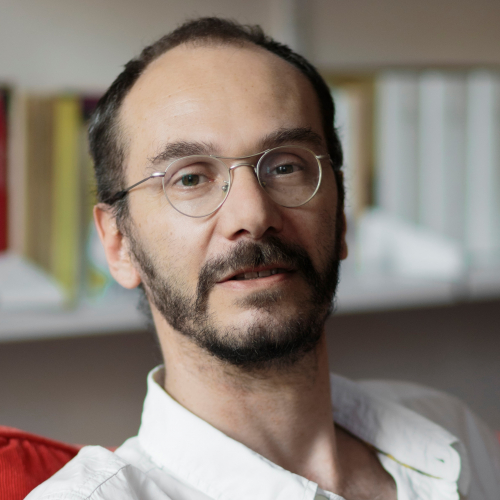
Roberto Vetrugno

Roberto Vetrugno

Roberto Vetrugno

Docente
Professore di II fascia
LIFI-01/A (ex L-FIL-LET/12)
Dipartimento di lingua, letteratura e arti italiane nel mondo (LILAIM)

Nota biografica

Roberto Vetrugno (1975) studied Modern Literature at the University of Pavia and was a student at Collegio Borromeo. He earned a PhD in Italian Linguistics and Stylistics at the University of Bologna with a dissertation dedicated to the language of Baldassarre Castiglione’s autograph letters. He was a research fellow and adjunct professor at the University of Pavia, a visiting professor at the University of Tripoli in 2013, and later a researcher at Nicolaus Copernicus University in ToruĊ„ (Poland).

His main research focuses on Renaissance letter exchanges and the courtly language: together with others, he edited the collection of Castiglione’s letters (Turin, Einaudi 2016), to which he has dedicated several works (Baldassar Castiglione, in Autografi dei letterati italiani, Rome 2009; The Language of Baldassar Castiglione as Epistolographer, Novara 2010; among the latest, Castiglione in Milan, in Renaissance in Transit in Milan (1450-1525), Milan, University of Milan, 2021; The Archives of Castiglione, Rome, Viella, 2023; Courtly Lexicon. Glossary of the Letters of Baldassarre Castiglione, Bologna, I libri di Emil, 2024).

He has explored the linguistic aspects of the letter collections of Isabella d’Este, Lucrezia Borgia, Vittoria Colonna, and other noblewomen of the sixteenth century, and has compiled his research in the volume "Prègola la non me voglia dementichare". Linguistic Studies on Renaissance Women’s Letters, Milan, Franco Angeli 2025. Since 2016, he has been involved in research dedicated to advanced levels of Italian L2 learning, including from a diachronic perspective. Since 2019, as rector’s delegate for the documentation and book heritage of the university, he has promoted a project for the transcription, analysis, and digitization of the University’s historical archive, presented in the recent Treccani volume dedicated to the history of the Stranieri (Learner Profiles and Italian L2 in the Historical Archive of the University for Foreigners of Perugia, in The University for Foreigners of Perugia. History of a University Open to the World, edited by Salvatore Cingari, Valerio De Cesaris, Gabriele Rigano, Roberto Vetrugno, Rome, Treccani, 2024, pp. 441-460). Since 2019, he has been the Rector’s Delegate for the enhancement of the University’s documentary, bibliographic, and artistic heritage.

Since September 2022, he has been president of the three-year degree course in Literature "Italian Language and Culture in the Digital World" and founded DigitaLab, a meeting place for the presentation and implementation of research dedicated to digital culture.

Insegnamenti

2025/2026

  • Grammatica ed errore nella lingua dell'apprendente di italiano l2/ls3 CFU

    Corso di laurea: Master di i livello in didattica dell'italiano lingua non materna

2024/2025

  • Laboratorio di italiano per la comunicazione3 CFU

    Corso di laurea: Comunicazione internazionale e pubblicitaria

  • Lingua italiana per stranieri9 CFU

    Corso di laurea: Digital humanities per l'italiano

  • Grammatica ed errore nella lingua dell'apprendente di italiano l2/ls3 CFU

    Corso di laurea: Master di i livello in didattica dell'italiano lingua non materna

  • Didattica dell'italiano contemporaneo2 CFU

    Corso di laurea: Master di ii livello in didattica dell'italiano lingua non materna

2023/2024

  • Laboratorio di italiano per la comunicazione3 CFU

    Corso di laurea: Comunicazione internazionale e pubblicitaria

  • Lingua italiana per stranieri9 CFU

    Corso di laurea: Digital humanities per l'italiano

2022/2023

  • Laboratorio di italiano per la comunicazione3 CFU

    Corso di laurea: Comunicazione internazionale e pubblicitaria

  • Lingua italiana per stranieri9 CFU

    Corso di laurea: Digital humanities per l'italiano

  • Fonetica e fonologia dell'italiano6 CFU

    Corso di laurea: Digital humanities per l'italiano

Back to top