Glossary
BES (Special Educational Needs) are defined as conditions that cause significant and relatively persistent difficulties in learning and/or participating in university life, such as: disabilities and impairments, specific learning disorders (SLD), borderline intellectual functioning, communication disorders, autism spectrum disorders, attention deficit and hyperactivity disorder (ADHD), movement disorders, psychiatric disorders, disabling medical conditions, as well as situations of severe socio-economic, linguistic or cultural disadvantage.
These conditions, which arise from the complex interaction between individual and environmental factors that can lead to discomfort, disadvantage or marginalization, require the adoption of targeted teaching strategies: it is, in fact, necessary to make adjustments in methodologies, materials and tools used during lessons, workshops and exams, in order to adequately meet each person's specific needs.
Specific learning disorders (SLDs) include dyslexia, dysgraphia, dysorthography, and dyscalculia. They manifest in the presence of adequate cognitive abilities and in the absence of neurological diseases or sensory deficits, but may still limit certain academic activities. They arise during developmental age, thus falling under neurodevelopmental disorders, and tend to persist over time with varying degrees and intensity. SLDs can affect various cognitive and operational processes, such as memorization, comprehension, planning, and both oral and written expression.
A person is considered to have a disability if they have long-term physical, mental, intellectual, or sensory impairments which, when interacting with various barriers, may hinder their full and equal participation in university life. Disability is the result of the interaction between health conditions, personal factors, and environmental factors: the presence of barriers or, conversely, facilitating elements can expand or limit opportunities for participation.
Concept maps are visual organizers of knowledge that help facilitate learning by integrating new information with prior knowledge, restructuring and expanding mental frameworks.
They can be used by students with specific learning disorders or disabilities as support for understanding and memorization, both for individual study and during exams, with prior approval from the teacher to ensure the suitability of this accommodation for the educational objectives.
Measurements
The following tables provide an illustrative list of the measures and support tools that can be adopted to promote the participation and fair assessment of students with BES/SLD certification.
The choice of measures to be granted must be agreed upon between the teacher and the student, according to their specific needs and in consultation with the University Disability and SLD Service (SDDA), which offers advice to teachers in defining the most appropriate adjustments.
Type | Purpose | Examples |
| Compensatory | Support the carrying out of educational and assessment activities | Concept maps, reading software, additional time, digital texts |
| Dispensative | Reduce or adapt non-essential tasks with respect to objectives | Exemption from reading aloud, adapted assessment, graphic simplification |
| Organizational | Facilitate participation and accessibility | Flexible schedules, classroom support, accessible materials |
Area | Purpose | Activatable measures and tools |
| EXAMS | Ensure fair and consistent conditions tailored to individual difficulties, without changing educational goals. | • Additional time for written tests • Additional time to reflect on answers during oral exams • Test in digital format • Presence of a reader/writer tutor • Use of PC with text-to-speech software • Possibility to take the exam at customized times and locations • Division of the test into several partial tests • Choice between written and oral tests • Choice among different written test formats (open questions or multiple choice) • Quantitative reduction, not qualitative, of the written test • Use of concept maps, outlines, or formula sheets, upon instructor approval at least 20 days before the exam |
LESSONS | Allow full participation in classroom or online teaching activities. | • Advance provision of slides or handouts (upon motivated request) • Viewing of sample exam papers already completed and guided review of errors • Access to materials in alternative formats (digital, audio, enlarged, etc.) • Possibility to independently record lessons, exclusively for personal use |
Handbook
Ensuring that the certification is properly filed with the SDDA Service allows for the application of the measures established by the University and for the fair organization of classes and exams.
The Rector's Delegate communicates with the instructor when a student requests specific measures for an exam, indicating the alignment of the requests with current regulations.
If the student contacts the instructor directly, it is possible to verify their status by reaching out to the SDDA Service or the Delegate. This step helps clarify any doubts about diagnoses, educational adaptations, or mediation methods, and assists in accurately managing even complex situations.
Requesting, from a student who explicitly asks for it, that conceptual maps be sent to the teacher at least 20 days in advance, with prior authorization from the Delegate, allows for timely evaluation.
Reviewing the maps means checking that the structure used and the information included are appropriate for the type of exam. If the map contains incorrect content or is excessively complex, the teacher can suggest the necessary changes so that the student can use it appropriately during the exam. This practice encourages more conscious preparation and helps identify any difficulties in studying.
Establishing an open dialogue makes it possible to understand the student's needs.
A respectful communication channel allows one to learn about study strategies and specific needs. Conversation fosters mutual trust and makes it possible to adapt teaching methods in a more inclusive way, supporting active participation during lessons, workshops, and exams.
Checking the total number of students with special needs in a degree program enables more inclusive educational planning.
Each year, after enrollment is complete, faculty receive information from the Rector’s Delegate, through the presidents of the Degree Programs, regarding the total number of students with special educational needs enrolled in the course. This data makes it possible to design lessons and exams inclusively and to monitor the overall accessibility of the academic path.
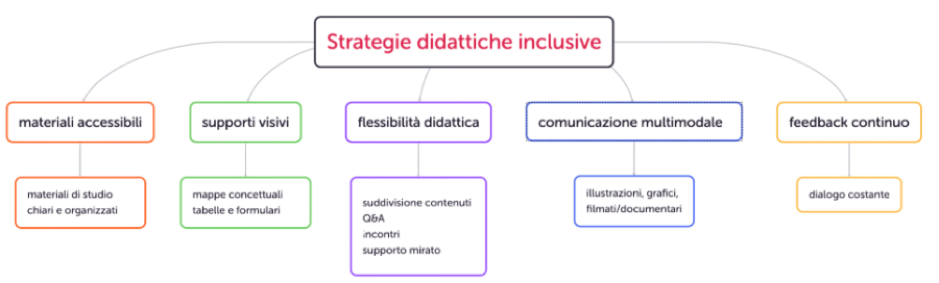
Applying inclusive teaching strategies encourages active participation and improves the accessibility of teaching.
To promote the academic success of students with special educational needs, specific learning disabilities, and disabilities, it is necessary to adopt teaching strategies that address different needs, including multimodal communication (that is, the combined use of oral explanations, written texts, images, and videos), the availability of easily accessible instructional materials, a certain degree of flexibility in organizing activities, the use of visual support tools, and the provision of continuous feedback during lessons, workshops, and exams.