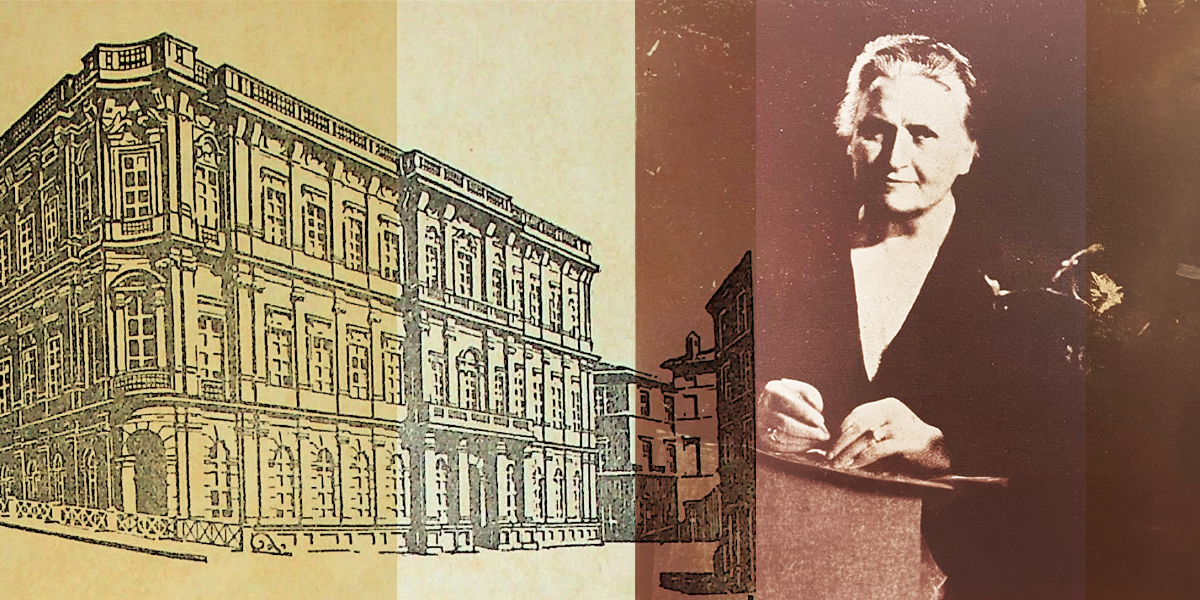
The departmental research center "Maria Montessori" (CeRiMM) was established with the aim of valuing and deepening Maria Montessori’s pedagogical approach through study, research, training, and innovation activities on topics related to educational innovation and inclusion. The Center aims to develop ideas and projects connected to Montessori pedagogy.
The pedagogical thought of Maria Montessori has its roots in a geographically well-defined territory, Umbria, which was frequently visited by the Doctor herself, who here not only encountered ideas from important peace thinkers such as Saint Francis in Assisi and Aldo Capitini in Perugia, but also wrote, in 1909, her most famous work “The Method of Scientific Pedagogy” in Città di Castello.
In 1950, she founded the Pedagogical Study Center (CSP) at the University for Foreigners of Perugia.
This magnificent university, for those who love Italians, with that deep kindness of the Italian spirit, has already called foreigners from everywhere to experience the beauties of art, which represents the powerful spirit that also created European and Italian civilization, in order to spread this Italian spirit throughout the world. It is a truth that leads toward peace, all together for me it represents something great and indescribable. I would like to properly thank all those who honored me by calling me, who gave me the privilege of being able to give this form that remains with me, directly to my country and directly to these Italian children from whom I have gathered everything I have. I would have nothing of what I have if I had not received it as a gift from those Italian children, whom I have spoken of everywhere in all parts of the world: from that group of children who first revealed to me, in Rome, that in mankind there is something unknown, but which is real and great, and which we must all remember. It is a plain fact, everyone understands, that the rapid progress of the last fifty years, in this age of science and machinery, has profoundly transformed relationships between people: this sudden change has created a great imbalance between the new environment and humanity, left here, as everywhere, unprepared to adapt to these new conditions. This is known to all. However, one fact should be revealed: education, which has the mission to help humanity rise, has preserved until today, here and elsewhere, outdated forms and systems, which are not adequate to improve people and make them aware of the great changes and the crises that our civilization is experiencing, crises about which everyone should be concerned. This gap between external progress and human progress is not minor, and in fact it is considered one of the causes of social conflict in our times: therefore, education is not only important within the realm of schooling, but the salvation of the world depends on it. UNESCO, which gathers all the educators of the world, was established with this in mind, so we must consider this institution not only as a tool for progress and cultural enrichment: UNESCO, through its purpose, contributes to world peace and has significance entirely on par, and just as powerful, as politics, which strives to prevent conflicts between nations. So now, everything done to improve human preparation, to achieve unity among all nations, has importance far beyond mere educational and cultural interest, and therefore, every effort in this direction becomes a social service. Drawing attention to the current state of schools, as I would like to do in this address, means looking not only at educational issues, but also into the most urgent social problems of our days, problems that call on everyone to cooperate. Schools have remained practically unchanged, as if they were something entirely unrelated to the fate of society [...].
A center like the one we want to create can be attended by people who believe in ideals in the world and in children: who want to prepare themselves for a mission, who want to become advocates for these ideals. In such people there can be only a missionary spirit; that is what we hope to inspire here, in the light of the grand traditions and art of the universities of the past. [...]
All who come to this Center, which aims to carry out research in the psychological and educational fields, through direct observation and the experiences we have had, must be enlightened by this light of truth and love for humankind, so that what we teach, the fruit of our long work, is not lost and the treasure of knowledge we have gathered from the children themselves is not dispersed. This rich mass of experiences and teachings must be preserved as a precious heritage so that it may live on in the memory and heart of all Italians and foreigners. This is the purpose of the program we intend to carry out in this series of lessons organized by the Center for Pedagogical Studies, which are open to anyone interested in these issues, so that they may find knowledge and truth from a great teacher: the soul of the child.
Excerpt from the inaugural address of the Center for Pedagogical Studies, given by Maria Montessori at the University for Foreigners of Perugia on July 20, 1950.
The University for Foreigners of Perugia today carries on this legacy through the establishment, almost 60 years after the closure of the Centre for Pedagogical Studies, of a Research Centre dedicated to the figure of Maria Montessori. A centre which, as Montessori herself stated during the inaugural speech delivered on July 20, 1950 and now preserved in the University's historical archive, aims to conduct research in the educational field, through on-site observation and the experiences carried out by teachers from around the world, so that everything that has been (and will be) discovered is not lost.
RAI Documentary
The Tgr Umbria and Rai Umbria documentary retraces a century of history of the University for Foreigners of Perugia, including the presence of Maria Montessori from minute 12:20.
- Gaggioli, C., Lupi, A., & Lanfranconi, C. (2025). Play and learning in Montessori contexts: Interpretative research between historical practices and contemporary educational scenarios / Gioco e apprendimento nei contesti montessoriani: una ricerca interpretativa tra pratiche storiche e scenari educativi contemporanei. QTimes – Journal of Education, Technology and Social Studies, 17(4), 331–347. [Article available in open access.]
- Gaggioli, C. (ed.) (2024). “Maria Montessori, a pedagogy for peace. Peace education pathways starting from preschool”. Lecce. Pensa Multimedia. [Available online in open access.]
- Gaggioli, C. (2023). From Maria Montessori to Media Education. Educational technologies between past and present. Nuova Secondaria, 41(2), 183–194.
- Gaggioli, C. (2023). Educating for peace in a world of war: Maria Montessori's heritage in the Umbria region. Italian Journal of Special Education for Inclusion, XI(1), 28–41.
Advanced Course “Maria Montessori: Pedagogy for Peace”
Customized Training Courses
The University for Foreigners of Perugia, in collaboration with CeRiMM, organizes, upon request from schools of all levels, training courses aimed at providing teachers with practical skills in the use of new technologies as facilitators in learning processes, with particular attention to students with Special Educational Needs (SEN). These courses also offer the opportunity to experientially deepen techniques for harmonizing traditional and digital learning environments, inspired by the principles of Montessori thought, aimed at creating an active and inclusive learning environment.
- “The integration between digital and learning environments: an experiential approach inspired by the Montessori method”
(10 hours to be held online or in person at schools) - “New technologies for facilitating learning in inclusive contexts”
(10 hours to be held online or in person at schools)
YouTopic Fest 2025 “The International Festival on Conflict”
Youtopic 25 | Panel: GENERATIVITY, RELATIONSHIP, TRUST: Comparing Educational Methods
Rondine Cittadella della Pace - 06/06/2025
Series of meetings promoted by CeRiMM
"Maria Montessori in Dialogue"
17 - 31 July 2025
Symposium “Maria Montessori: Pedagogy for Peace”
15 July 2024, Aula Magna, Palazzo Gallenga
Event recording
You can visit the exhibition set up in the Gallenga-Stuart library collection room, on the second floor of Palazzo Gallenga, free of charge, by reservation.
The exhibition features documents and correspondence that testify to the relationship between Maria Montessori and the University for Foreigners of Perugia starting from the late 1940s.